Scales · Turkish version · 2026
Mind Excessively Wandering Scale (MEWS)
Turkish: Zihinsel Aşırı Gezinme Ölçeği (ZAGÖ)
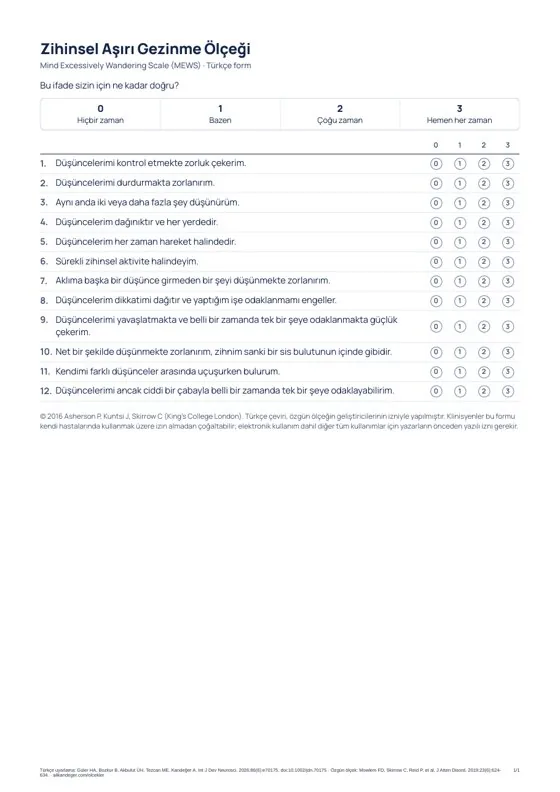
A 12-item self-report scale of excessive mind wandering: thoughts that keep moving, uncontrolled, from one topic to another. The Turkish version was tested in adolescents with ADHD and a control group.
- 12 items
- Self-report
- Rated 0–3
- One factor
- Turkish form · PDF
What does it measure?
- Difficulty controlling and switching off one's thoughts
- Several thoughts running at once, and flitting between thoughts
- Ceaseless mental activity and inner restlessness
- Thoughts that distract and get in the way of focusing on the task at hand
How is it used?
- A 12-item form that people fill in themselves.
- For each item people answer 'How true is this statement of you?' from 0 (Not at all or rarely) to 3 (Nearly all of the time).
- The original scale was developed for adult ADHD; the Turkish version was tested in adolescents.
Scoring
The total is the sum of the 12 item scores and ranges from 0 to 36; higher scores mean more mind wandering. There are no subscales and no reverse-scored items.
The Turkish version
- 156 adolescents: 80 with ADHD and 76 controls (mean age 15.1); ADHD was diagnosed with a semi-structured clinical interview.
- Confirmatory factor analysis supported the original one-factor, 12-item structure (χ²/df 1.88; RMSEA 0.075; SRMR 0.048; CFI 0.98).
- Internal consistency: Cronbach's α = 0.93; McDonald's ω = 0.93; item-total correlations 0.46–0.85.
- Scores were clearly higher in adolescents with ADHD than in controls (d = 0.82) and related to difficulties in emotion regulation (r = 0.77) and impulsivity (r = 0.55).
References
Turkish version
Güler HA, Bozkur B, Akbulut ÜH, Tezcan ME, Kandeğer A. Psychometric evaluation of the Turkish Mind Excessively Wandering Scale in adolescents with ADHD: exploratory findings on age-related differences in excessive mind wandering. Int J Dev Neurosci. 2026;86(6):e70175. doi:10.1002/jdn.70175
Original scale
Mowlem FD, Skirrow C, Reid P, Maltezos S, Nijjar SK, Merwood A, Barker E, Cooper R, Kuntsi J, Asherson P. Validation of the Mind Excessively Wandering Scale and the relationship of mind wandering to impairment in adult ADHD. J Atten Disord. 2019;23(6):624-634. doi:10.1177/1087054716651927
A scale does not make a diagnosis on its own; scores should be read alongside a clinical assessment. When you use a scale, please cite the Turkish validation paper and the original scale.