Scales · Turkish version · adults with ADHD
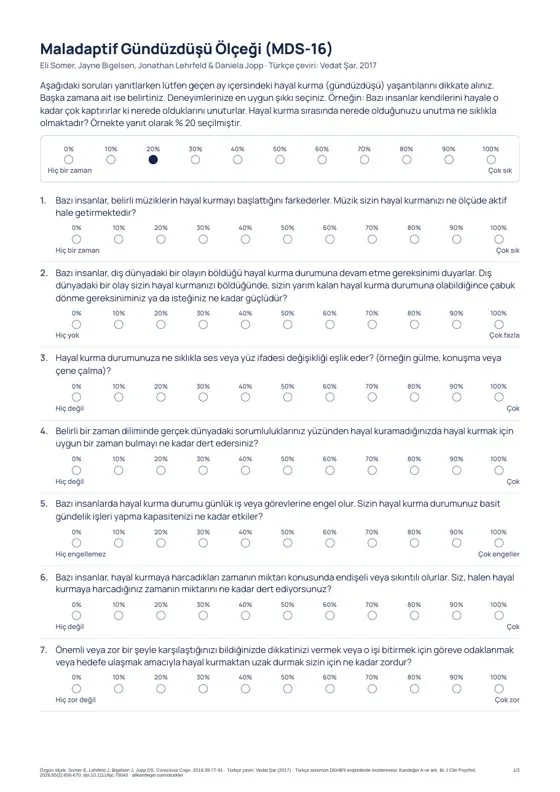
Maladaptive Daydreaming Scale (MDS-16 · MDS-5)
Turkish: Uyumsuz Hayal Kurma Ölçeği (MDS-16 · MDS-5)
Title of the Turkish translation: Maladaptif Gündüzdüşü Ölçeği (Vedat Şar, 2017)
A 16-item self-report scale of maladaptive daydreaming: hours of absorbing, immersive daydreams that get in the way of daily life. Its five-item short form (MDS-5) can be used as a quick screen.
- 16 items · short form 5
- Self-report
- 0–100% answers
- 4 subscales
- Turkish form · PDF
What does it measure?
- The urge to daydream and reactions when a daydream is interrupted
- How daydreaming gets in the way of daily tasks, life goals and academic or work success
- Walking, rocking, sounds and facial expressions that go with daydreaming (kinesthesia)
- Music starting and sustaining daydreams
How is it used?
- A 16-item form that people fill in themselves, thinking of their daydreaming over the past month.
- Each item is answered from 0% to 100% in steps of 10%; the end labels differ by item (e.g. Never – Very often).
- The short form (MDS-5) uses items 4, 5, 8, 9 and 14 of the MDS-16.
Scoring
Each item is scored 0–100. The total is the mean of the 16 items and each subscale is the mean of its items (0–100); higher scores mean more marked maladaptive daydreaming. Subscales follow the four-factor model.
| Subscale | Items | Score range |
|---|---|---|
| Yearning | 2, 4, 10, 12, 13, 15 | 0–100 |
| Impairment | 5, 6, 7, 8, 9, 11 | 0–100 |
| Kinesthesia | 3, 14 | 0–100 |
| Music | 1, 16 | 0–100 |
| MDS-5 (short form) | 4, 5, 8, 9, 14 | 0–100 |
The Turkish version
- 357 adults: 251 with ADHD and 106 controls (mean age 24.3).
- Confirmatory factor analysis supported the four-factor structure of the MDS-16 (χ²/df 3.33; CFI 0.98; SRMR 0.05; RMSEA 0.08); the MDS-5 also fitted well (χ²/df 3.17; CFI 0.99; SRMR 0.022; RMSEA 0.078).
- Internal consistency: Cronbach's α = 0.93 for the MDS-16 (subscales 0.62–0.94) and 0.87 for the MDS-5.
- After adjusting for age, education, anxiety and depression, all scores were higher in adults with ADHD; the largest difference was in Impairment (η² = 0.17).
- Impairment items overlapped most with ADHD; Yearning, Music and Kinesthesia items appear more specific to maladaptive daydreaming.
References
This page's study · adults with ADHD
Kandeğer A, Bozkur B, Güler HA, İspir Çaltıner ŞN, Demirel HR, Selvi Y. Psychometric properties of the Turkish Maladaptive Daydreaming Scale (MDS-16) and its short form (MDS-5): an item-level examination in adults with ADHD. Br J Clin Psychol. 2026;65(2):656-670. doi:10.1111/bjc.70043
Turkish translation
Somer E, Bigelsen J, Lehrfeld J, Jopp D. Maladaptive Daydreaming Scale (MDS-16), Turkish version. Translated by Vedat Şar; 2017.
Original scale
Somer E, Lehrfeld J, Bigelsen J, Jopp DS. Development and validation of the Maladaptive Daydreaming Scale (MDS). Conscious Cogn. 2016;39:77-91. doi:10.1016/j.concog.2015.12.001
Short form
Soffer-Dudek N, Oh H. Maladaptive daydreaming: a shortened assessment measure and its mental health correlates in a large United States sample. Compr Psychiatry. 2024;129:152441. doi:10.1016/j.comppsych.2023.152441
A scale does not make a diagnosis on its own; scores should be read alongside a clinical assessment. When you use a scale, please cite the Turkish validation paper and the original scale.